
Beyond Tokyo and Osaka: Taiwanese Travelers Enter the "Repeat Visit Era" as Fukuoka Buzz Surges Over 85% Year-on-Year

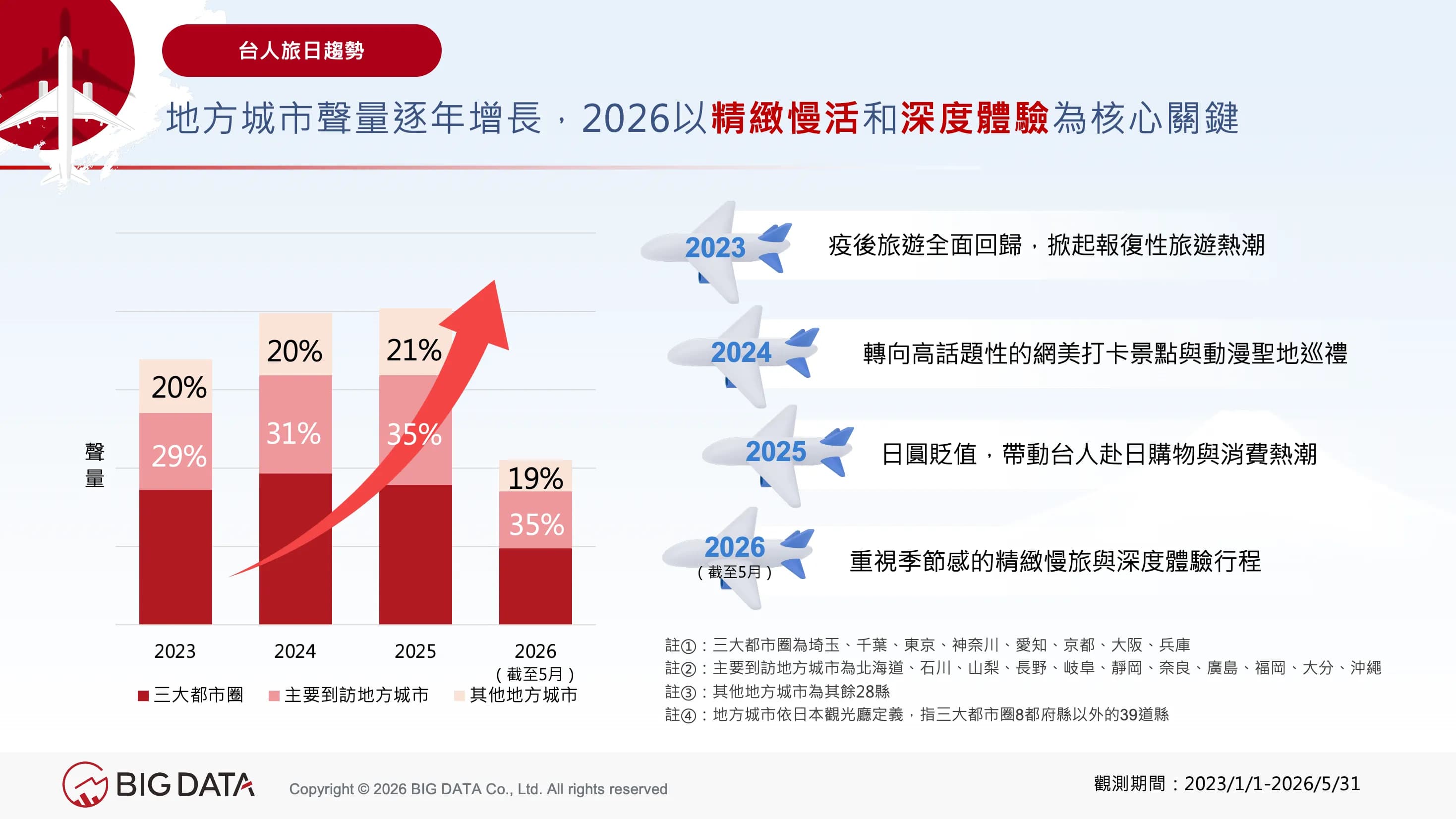
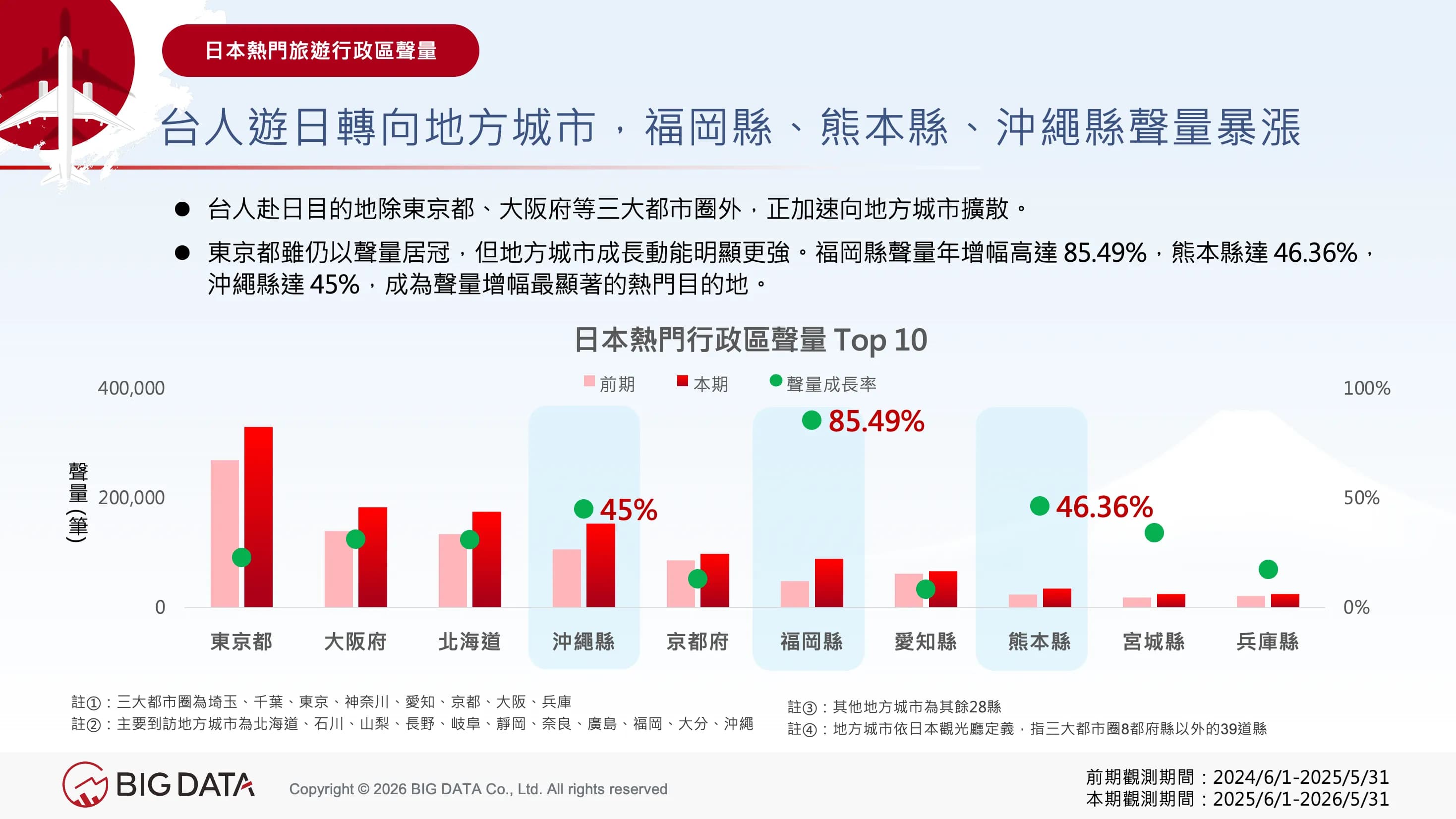
As Japan shifts from "where to go first" to "where to go next," the travel map for Taiwanese visitors to Japan is changing. BIG DATA Co., Ltd., Taiwan's leading data technology company, today (27th) released its latest report, Japan's Regional Cities Strike Back: How Emerging Travel Favorites Are Capturing Taiwanese Curiosity. Using KEYPO Big Data Intelligence, its public opinion analytics software, to track online buzz related to Taiwanese travel to Japan between January 1, 2023 and May 31, 2026, the report finds that Taiwanese travelers' interest in regional cities outside Japan's three major metropolitan areas continues to grow. In the first five months of 2026, regional cities accounted for 35% of total travel-related buzz, up markedly from 29% in 2023 — while the share held by the three major metropolitan areas has declined year over year from 51%, signaling that Taiwanese travelers' destination choices in Japan are steadily extending outward. Among regional destinations, Fukuoka Prefecture topped the growth chart with an 85.49% year-on-year increase in buzz, driven by newly launched direct flights from Taiwan, the ability to self-drive across Kyushu, and the rise of immersive local experiences. Kumamoto Prefecture and Okinawa Prefecture followed closely with growth of 46.36% and 45% respectively, emerging as the most notable "regional dark horses" on the Japan travel map. Weiwei Chiang, COO of BIG DATA, said that as Taiwanese travelers accumulate more trips to Japan, and as regional direct flight routes and self-drive/charter travel options expand, travel decisions are shifting from checking off popular landmarks to seeking in-depth local experiences. The rise of regional cities reflects more than a reshuffling of popular destination rankings — it marks Taiwanese travelers' formal entry into a "Repeat Visit Era" centered on local exploration, personal interests, and immersive experiences, sending an important signal for tourism operators, airlines, and local governments to reposition their strategies.
TSMC (JASM) Sets Up in Kumamoto — Semiconductor Effect Unexpectedly Fuels a New Wave of Regional Tourism
Fukuoka, Kumamoto, and Okinawa Lead the Way as the Top Three Regional Cities by Buzz Growth
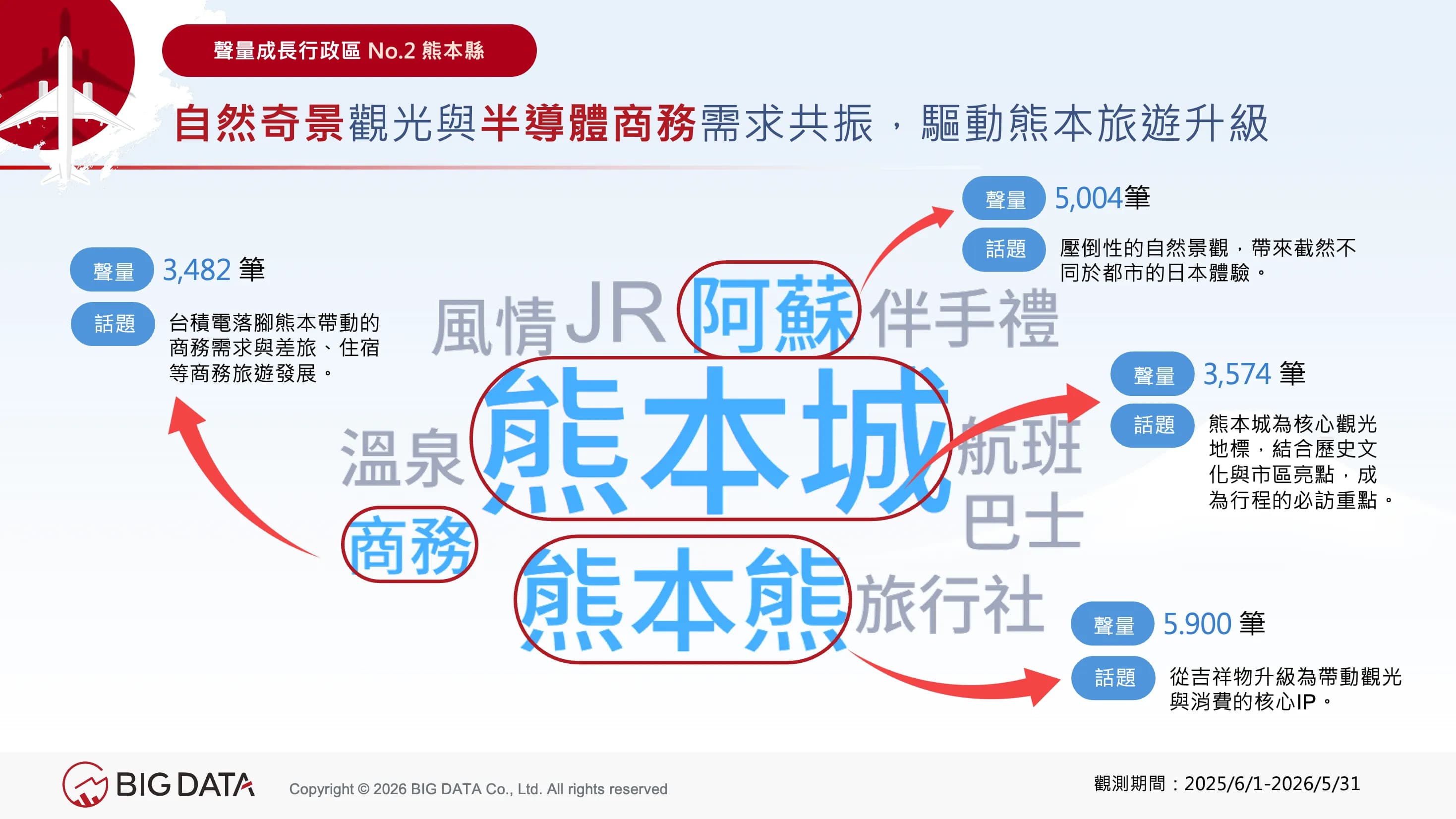
According to the KEYPO Big Data Intelligence, the top three regional cities by buzz growth are Fukuoka Prefecture, Kumamoto Prefecture, and Okinawa Prefecture. While all three have risen strongly, the drivers behind their growth differ. Fukuoka Prefecture topped regional buzz growth with an 85.49% year-on-year increase, powered by a combination of newly opened direct flight routes, self-drive itineraries connecting Kyushu attractions, and growing interest in slower-paced, immersive travel — gradually transforming Fukuoka from a transit city into a destination valued for both direct access and depth of experience. Kumamoto Prefecture followed with 46.36% growth, driven by its dramatic natural landscapes and cultural attractions centered on Kumamoto Castle, along with TSMC's (JASM) establishment in Kumamoto, which drove a 78% surge in business-related discussion compared to the prior period — an unexpected tourism effect from the semiconductor industry that is turning Kumamoto into a dual-track destination for both business travel and leisure tourism. Okinawa Prefecture rounded out the top three with 45% growth, continuing to solidify its position as a top choice for self-drive trips and island getaways, thanks to low-barrier self-drive itineraries and water-based activities suitable for travelers of all ages.
Crowds and "Novelty Fatigue" in the Three Major Metropolitan Areas Push Travelers to Explore Beyond
Tokyo, Osaka, and Kyoto's Visitor Share Declines for Three Consecutive Years as Travelers Seek "the Next Japan"
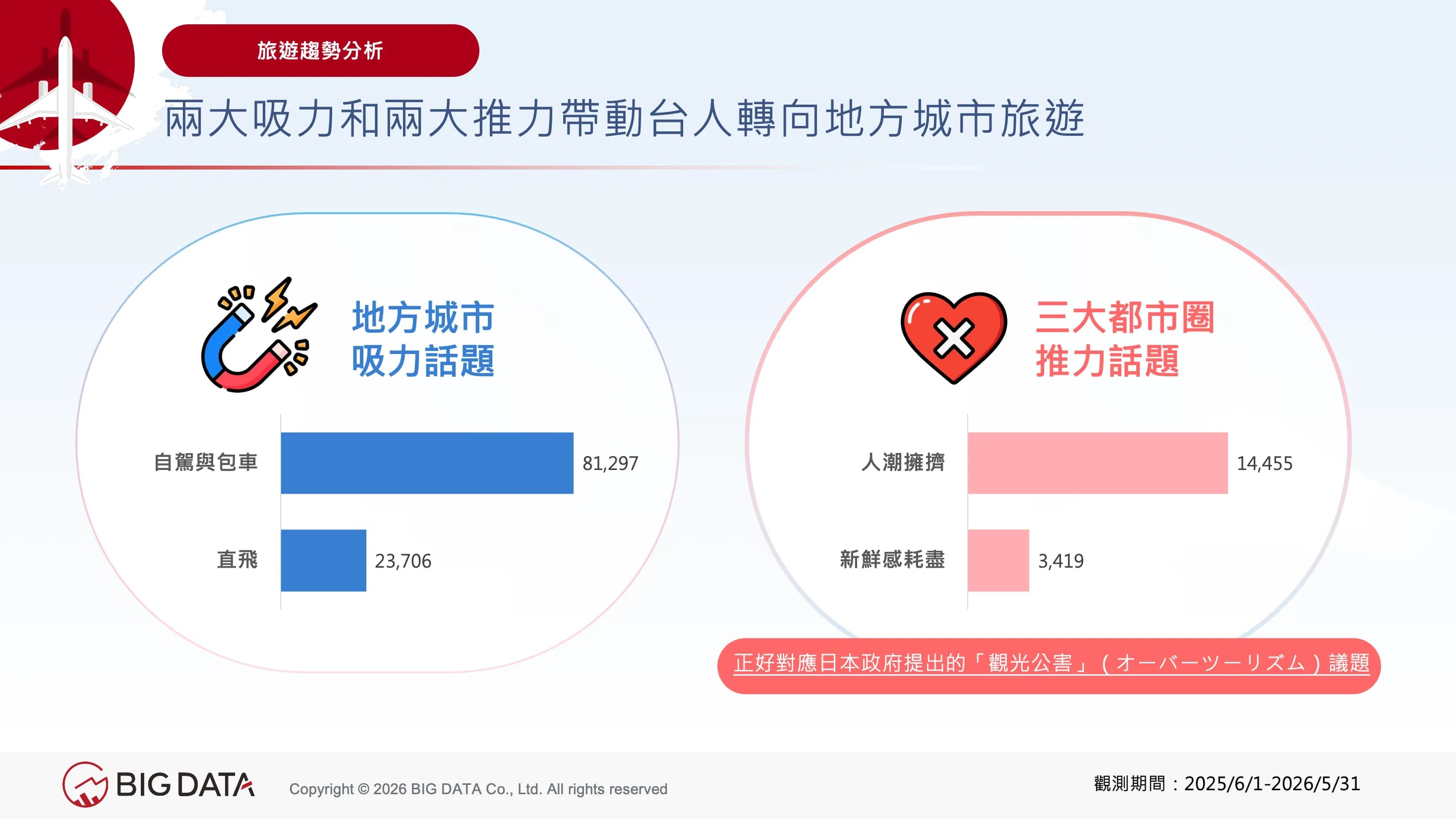
According to the Japan National Tourism Organization, the share of Taiwanese visitors traveling to Tokyo fell from 37.3% to 31% between 2023 and 2025, Osaka Prefecture's share fell from 29.2% to 23.7%, and Kyoto Prefecture's share fell from 21.5% to 15.4% — showing a continued decline in visitor share across Japan's three most popular prefectures. This "exodus" is being driven by two key factors: overcrowding, with related discussion volume up 35.32% compared to the prior period, and "novelty fatigue," with discussion volume surging even more sharply at 83.92%. This reflects that after multiple visits to Tokyo, Osaka, and Kyoto, travelers are growing tired of classic itineraries and beginning to seek fresh travel experiences. At the same time, Tokyo travel is showing a "city center to suburban" dispersion trend, with discussion around suburban destinations such as Mount Takao and Ome City quietly heating up — signaling that Taiwanese travelers are beginning to seek out lesser-known experiences even within familiar cities, laying the groundwork for the rise of regional destinations.
Direct Flights and Self-Drive/Charter Travel Open a New Blue Ocean for Regional City Tourism
From Fast-Paced City Trips to Slow Regional Travel — Improved Transportation Unlocks In-Depth Exploration
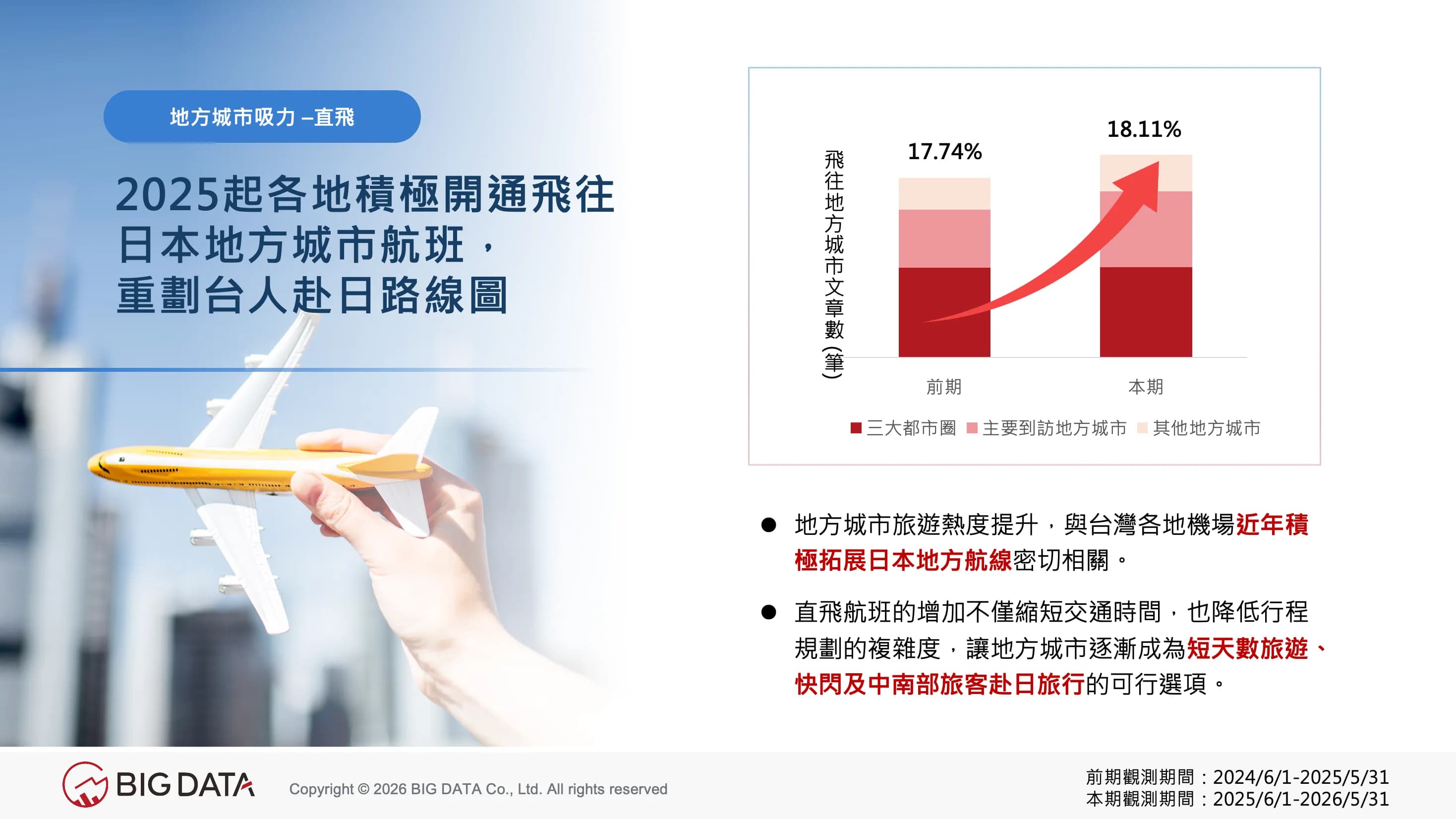
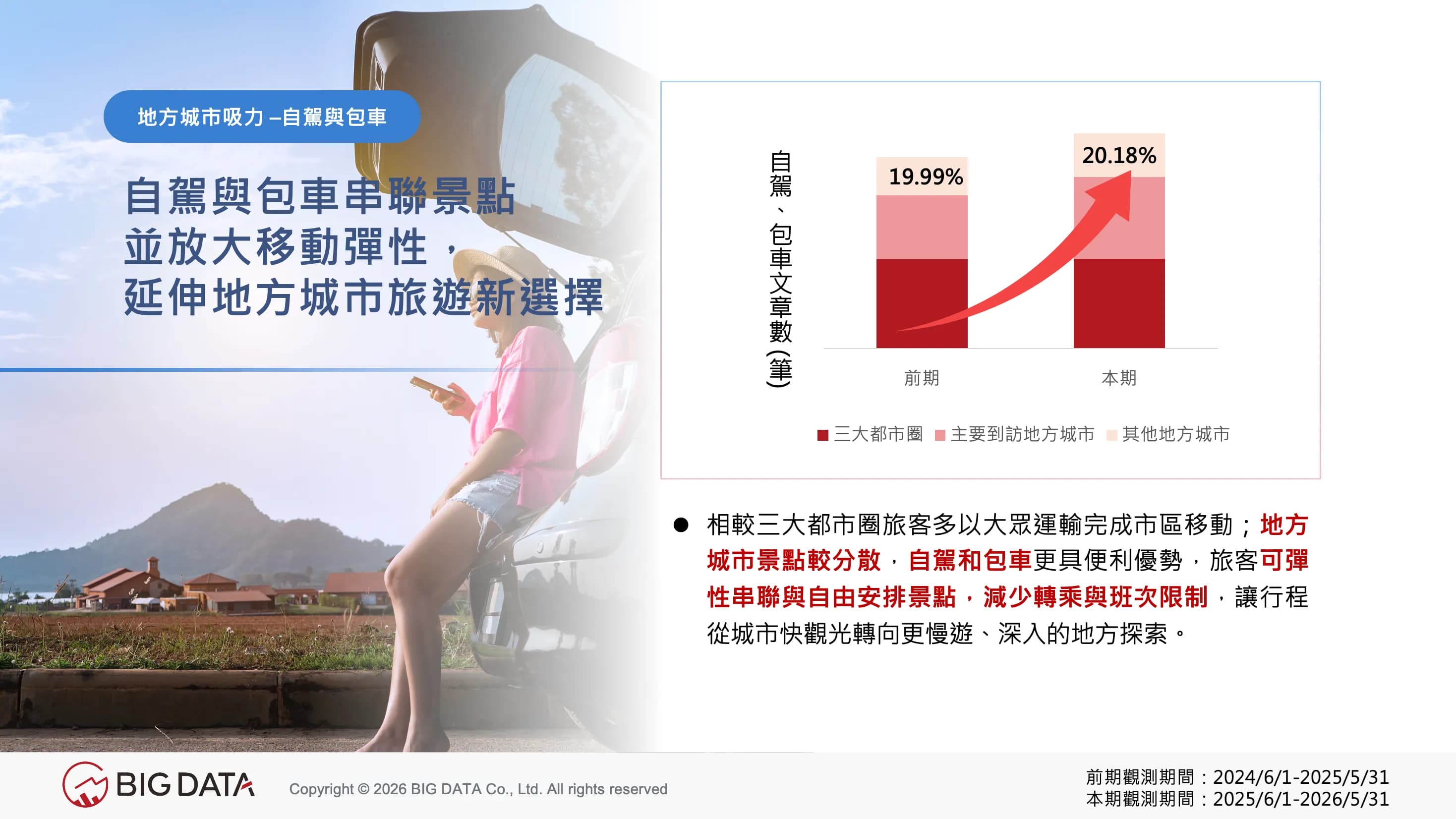
As push factors emerge from the three major metropolitan areas, regional cities are simultaneously offering two key pull factors to capture this flow of travelers. The first is the launch of new direct flight routes — including Tainan and Taichung to Kumamoto and Okinawa, and Taipei to Fukuoka — gradually making regional cities a viable option for short getaways as well as for travelers departing from central and southern Taiwan; discussion volume related to flights to regional cities grew 18.11% compared to the prior period. The second is the growing popularity of self-drive and charter travel, which makes it easier to connect regional attractions that are otherwise spread out, shifting itineraries from city sightseeing toward slower, more in-depth regional exploration; related discussion volume grew 20.18% in parallel — with self-drive and charter travel moving from a "nice-to-have option" to a "standard feature" of regional deep travel.
At the core of this shift is Taiwanese travelers' formal entry into the "Repeat Visit Era." As Tokyo and Osaka are no longer the default answer for a trip to Japan, travelers with multiple prior visits are turning their attention to destinations such as Fukuoka, Okinawa, Okayama, Hiroshima, Aomori, and Kumamoto — choosing based on personal interests, accommodation experience, transportation convenience, and crowd density, and crafting their own second, third, or even multiple return trips to Japan. Compared to first-time visitors chasing classic landmark photo ops, repeat travelers tend to favor a more everyday pace, exploring the daily texture of regional cities in greater depth.
BIG DATA Co., Ltd. notes that Taiwanese travel to Japan is shifting toward being more regional, more immersive, and more personalized. As regional direct flight routes continue to expand, this shift away from the three major metropolitan areas is expected to continue. High-quality, low-density destinations — such as the Aomori Nebuta Festival, Shikoku's railway routes, or the Setouchi Triennale — may emerge as the next wave of popular destinations, with travel styles becoming increasingly diverse: from slow self-drive trips and overnight sleeper trains to anime pilgrimage tours and traditional sento bathhouses. Taiwanese travelers are gradually transforming from sightseers into "lifestyle experiencers," seeking a more personalized way to experience Japan.
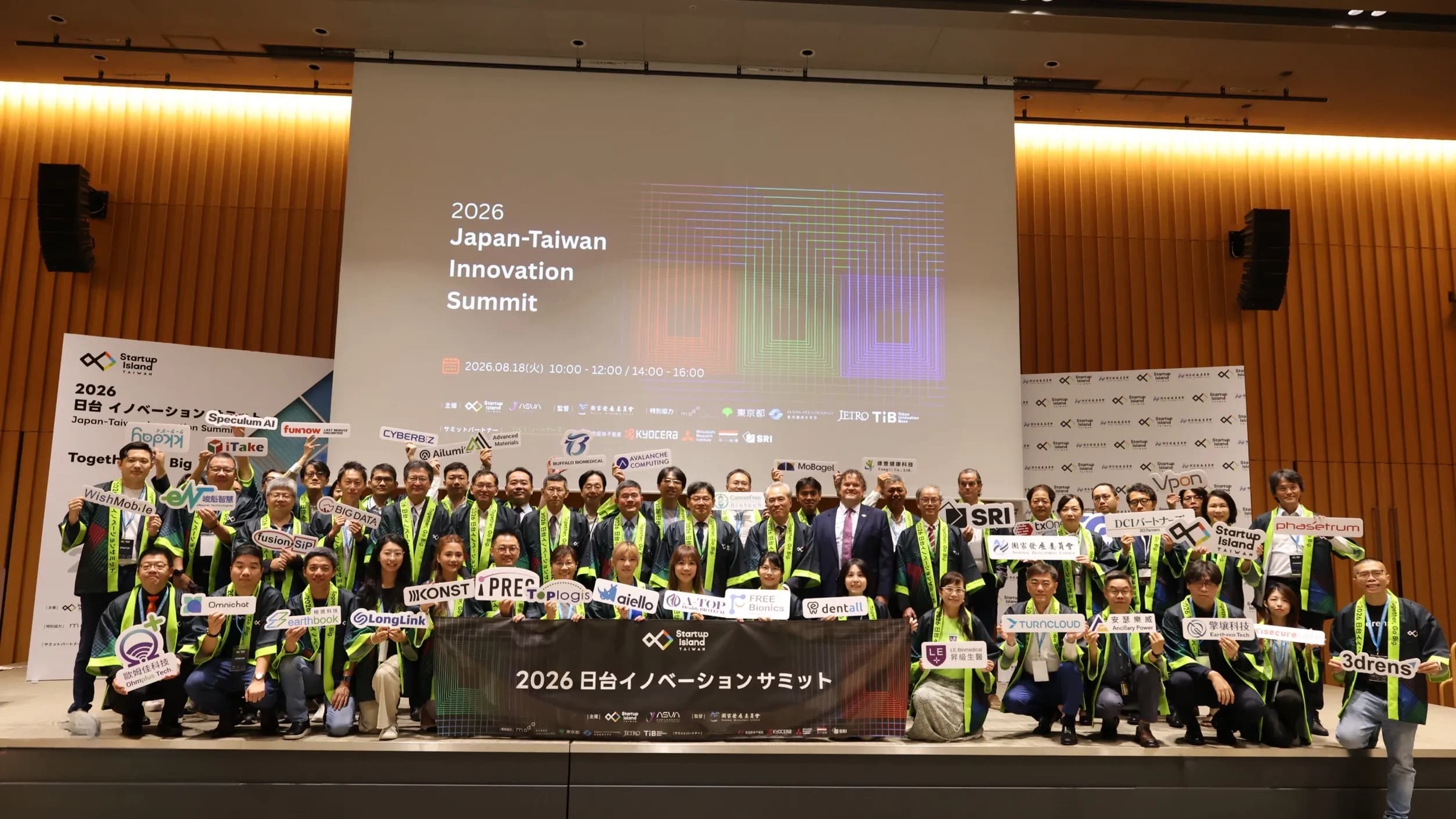
Accelerating Global Expansion: BIG DATA Takes the Stage at the 2026 Japan-Taiwan Innovation Summit
Following its first-ever participation in SusHi Tech Tokyo in Japan this past April and its appearance at 2026 LEAP East in Hong Kong in July, BIG DATA Co., Ltd. — Taiwan's leading data technology company — will make its debut appearance at the 2026 Japan-Taiwan Innovation Summit on August 18-19, the flagship annual international innovation event launched by Startup Island TAIWAN, the national startup brand created by Taiwan's National Development Council (NDC). The summit brings together key Taiwan-Japan representatives including NDC Minister Chun-Hsien Yeh, Tokyo Governor Yuriko Koike, and JETRO Director Tomohiro Takashima, making it one of the highest-visibility annual exchange events for Taiwanese startups in Japan. BIG DATA will showcase two AI solutions to Japanese enterprises and industry partners: the newly upgraded “KEYPO Agent” and the “KEYLM — Private AI Platform for Enterprise Knowledge”, demonstrating Taiwan's technical capabilities in AI, data governance, and enterprise decision-making applications, while continuing to pursue local partnership opportunities to deepen its presence in the Japanese market. WeiWei Chiang, COO and Spokesperson of BIG DATA, said Japan is one of the company's key markets for overseas expansion. From participating in international exhibitions and engaging local enterprises to seeking technical and business collaboration opportunities, BIG DATA hopes that sustained, long-term market engagement will help it better understand the actual needs of Japanese enterprises and bring Taiwan's mature data and AI application experience into the Japanese market.

BIG DATA's KEYLM Intelligent Government Assistant Runs on NVIDIA's Integrated Hardware-Software Architecture
BIG DATA Co., Ltd., a leading data technology company in Taiwan, today announced the launch of KEYLM, an intelligent government assistant solution purpose-built for government decision support and legislative briefing. KEYLM brings together BIG10 (the company's proprietary domain language model trained on over 6.5 billion Traditional Chinese tokens accumulated over more than a decade) with an AI Agent platform, powered by NVIDIA DGX Spark as its on-premises compute foundation. By incorporating NVIDIA NeMo Framework and NVIDIA NeMo Agent Toolkit to strengthen model fine-tuning and Agent governance, KEYLM delivers a full-stack, single-device on-premises deployment that keeps responses traceable, processes auditable, and performance elevated. "Sovereign AI demand is accelerating globally, and public sector agencies are under growing pressure to keep data on-premises while meeting increasingly strict security and compliance requirements," said Weiwei Chiang(蔣志薇), COO and Spokesperson of BIG DATA. "KEYLM runs on NVIDIA's integrated hardware-software architecture, and at the same time fills a longstanding gap: Traditional Chinese has historically been underrepresented in international AI training data. We built KEYLM to give government agencies an AI model that genuinely understands Taiwan's linguistic and institutional context, and solves three real operational problems: fragmented institutional knowledge, slow and inconsistent manual synthesis, and the inability to move sensitive data to the cloud."

BIG DATA Debuts New KEYPO Features at 2026 LEAP East
The era of generative AI is rapidly transforming how users worldwide search for and access information, as well as how enterprises make decisions. Brand management is also evolving from traditional social media monitoring to a new stage that simultaneously encompasses "AI Listening." Taiwan-based AI data technology company BIG DATA Co., Ltd. is participating in the Asian tech event 2026 LEAP East for the first time, showcasing the brand-new AI Listening feature of AI Public Opinion Analytics Software, KEYPO, which helps enterprises comprehensively grasp their brand influence across both AI and social ecosystems. The company is also presenting its corporate due diligence platform KEYKYC, along with the content analysis platforms DailyView and Hong Kong DailyView, offering a complete one-stop AI data solution spanning brand intelligence, corporate trust, risk management, and industry analysis. WeiWei Chiang, Chief Operating Officer of BIG DATA Co., Ltd., stated that AI is redefining how enterprises obtain market intelligence and understand consumers. Through KEYPO, the company helps enterprises build more comprehensive brand insight capabilities in the AI era. This year, BIG DATA has continued to accelerate its overseas expansion, having been selected in April as one of the exhibiting teams under Startup Island TAIWAN to participate in SusHi Tech Tokyo, and is now advancing into Hong Kong. The company hopes that through 2026 LEAP East, it can establish partnerships with Asian enterprises, continue expanding into overseas markets, and build further momentum toward its planned IPO.